
Key Takeaways
- AI-enabled CRM turns customer data into faster actions. It improves decisions, automation, and customer experiences.
- AI-powered CRM reduces manual work and boosts productivity. Teams focus more on selling and customer relationships.
- The right AI CRM software delivers measurable business value. Better data and smart implementation drive long-term growth.
Why Businesses Are Moving to AI-Powered CRM
Businesses are adopting AI-powered CRM to automate work, improve customer experiences, and make faster decisions.
Faster Decision-Making
AI CRM systems analyze customer data and engagement in real time. Teams receive instant insights, prioritize leads faster, and make informed decisions with greater confidence.
Better Customer Experiences
AI-powered CRM personalizes every interaction using customer behavior and preferences. Automated communication and timely follow-ups improve engagement, satisfaction, and customer loyalty.
Higher Sales Productivity
CRM automation eliminates repetitive administrative work and streamlines daily tasks. Sales teams spend more time selling and less time updating records or managing workflows.
Smarter Business Insights
AI CRM software converts customer data into actionable business insights. Organizations use these insights to improve forecasting, optimize operations, and support smarter strategic decisions.
Key Features Every AI CRM Software Should Have
Modern AI CRM software combines automation, predictive insights, and intelligent data analysis.
Intelligent Lead Scoring
AI-powered CRM scores leads using customer behavior and historical data. Sales teams can prioritize the best opportunities faster.
Sales Forecasting
Predictive analytics forecasts revenue and sales trends using real-time data. This supports smarter business decisions.
CRM AI Agents
CRM AI agents automate routine tasks, qualify leads, and assist customer interactions. Teams save time and stay productive.
AI Customer Service Automation
AI customer service automation delivers instant responses through chatbots and virtual assistants. Customers receive faster and more consistent support.
CRM Data Intelligence
CRM data intelligence converts customer data into actionable insights. Businesses better understand customer behavior and opportunities.
Automated Workflows
CRM automation with AI automates follow-ups, task assignments, and data entry. This reduces manual work and improves efficiency.
Essential AI Technologies Behind Modern CRM
Modern AI in CRM combines multiple technologies to automate tasks, analyze customer data, and improve decision-making.
Machine Learning
Machine learning identifies patterns in customer data to improve lead scoring, forecasting, and recommendations. It becomes more accurate as new data is collected.
Generative AI
Generative AI creates emails, summaries, and personalized content in seconds. This helps teams communicate faster while maintaining relevance.
Natural Language Processing (NLP)
Natural language processing (NLP) enables CRM systems to understand customer messages and conversations. It powers chatbots, sentiment analysis, and intelligent customer support.
Real-World Use Cases of AI in CRM
AI in CRM helps businesses automate operations, personalize customer interactions, and make better decisions. It improves efficiency while delivering more valuable customer experiences.
AI Sales Automation
AI-powered CRM automates lead scoring, qualification, and follow-ups. Sales teams close deals faster and focus on high-value prospects.
Marketing Personalization
AI analyzes customer behavior and purchase history to personalize marketing campaigns. This improves engagement and campaign performance.
Customer Support Automation
AI chatbots provide instant answers and handle routine customer inquiries. Support teams spend more time resolving complex issues.
Customer Churn Prediction
Predictive analytics identifies customers likely to leave using historical data. Businesses can act early to improve retention.
Next-Best-Action Recommendations
AI recommends the most effective next step based on customer data and behavior. This helps teams deliver timely and relevant interactions.
Industries Benefiting Most from AI-Enabled CRM
AI-enabled CRM helps organizations automate processes, personalize customer experiences, and make data-driven decisions.
Retail and eCommerce
Retail and eCommerce businesses use AI-enabled CRM to personalize shopping experiences, recommend products, and improve customer loyalty through data-driven insights.
Healthcare and Financial Services
Healthcare and financial organizations use AI to streamline customer communication, improve service quality, and manage sensitive customer data securely.
B2B Sales and Professional Services
B2B companies use AI-powered CRM to prioritize leads, automate follow-ups, and strengthen client relationships. This improves sales efficiency and long-term business growth.
Benefits of AI CRM Solutions for Modern Businesses
AI CRM solutions help businesses automate processes, improve decision-making, and deliver better customer experiences.
Increased Productivity
AI-powered CRM automates repetitive tasks and reduces manual work. Employees spend more time on high-value activities.
Improved Forecasting
Predictive analytics analyzes historical data and customer behavior to improve sales forecasting. Businesses can make more confident decisions.
Better Customer Retention
Personalized experiences, faster support, and sentiment analysis strengthen customer relationships. This helps reduce customer churn over time.
Faster Response Times
AI-powered chatbots and virtual assistants provide instant responses around the clock. Customers receive timely support across multiple channels.
Higher ROI
Automation, smarter lead scoring, and improved productivity increase business efficiency. These improvements help maximize long-term return on investment.
How to Successfully Implement AI CRM
A successful AI CRM implementation depends on planning, quality data, and user adoption. Following a structured approach helps businesses maximize ROI and reduce implementation risks.
Define Business Goals
Start with clear business objectives and a high-impact use case. Defined goals make implementation more focused and measurable.
Prepare Clean CRM Data
AI-powered CRM performs best with accurate and organized customer data. Clean data improves AI models and decision-making.
Choose the Right AI CRM Platform
Select a platform that supports CRM integration, ERP integration, and future scalability. The right solution simplifies implementation and growth.
Train Users and Monitor Performance
Provide team training to encourage user adoption and build trust. Monitor performance regularly and refine the system for continuous improvement.
How to Prepare Your Business for AI CRM Adoption
Preparing for AI CRM implementation ensures a smoother transition and better results. A strong foundation helps businesses maximize the value of AI from day one.
Audit Your Existing CRM
Review your current CRM processes, workflows, and integrations. Identify gaps that AI can improve.
Clean Customer Data
Remove duplicate and outdated records before implementation. Clean data improves AI accuracy and performance.
Set Measurable Success Metrics
Define goals such as higher conversions, faster response times, or improved productivity. Tracking these metrics helps measure implementation success.
Common Mistakes to Avoid When Adopting AI CRM
Adopting AI CRM requires more than adding new technology. Avoiding common mistakes helps businesses achieve better results and long-term value.
Relying on Poor-Quality Data
AI performs best with clean and accurate customer data. Poor data quality leads to unreliable insights and weaker decisions.
Ignoring User Training
Employees need proper training to use AI tools effectively. Better adoption leads to higher productivity and stronger outcomes.
Automating Without Clear Goals
Automation should support defined business objectives. Clear goals ensure AI CRM delivers measurable improvements and lasting ROI.
Common Challenges and How to Overcome Them
Implementing artificial intelligence in CRM offers significant benefits, but it also brings challenges.
Poor Data Quality
AI in CRM depends on accurate and complete customer data. Regular data cleaning improves AI performance and decision-making.
User Adoption
Employees need proper training and clear guidance to trust AI tools. Strong adoption increases productivity and long-term success.
Privacy and Security
Businesses must protect customer data through cybersecurity, data privacy, and regulatory compliance. Strong security builds customer trust.
Integration with Existing Systems
Choose AI-powered CRM platforms that integrate smoothly with existing CRM and business systems. Seamless integration reduces implementation challenges and improves efficiency.
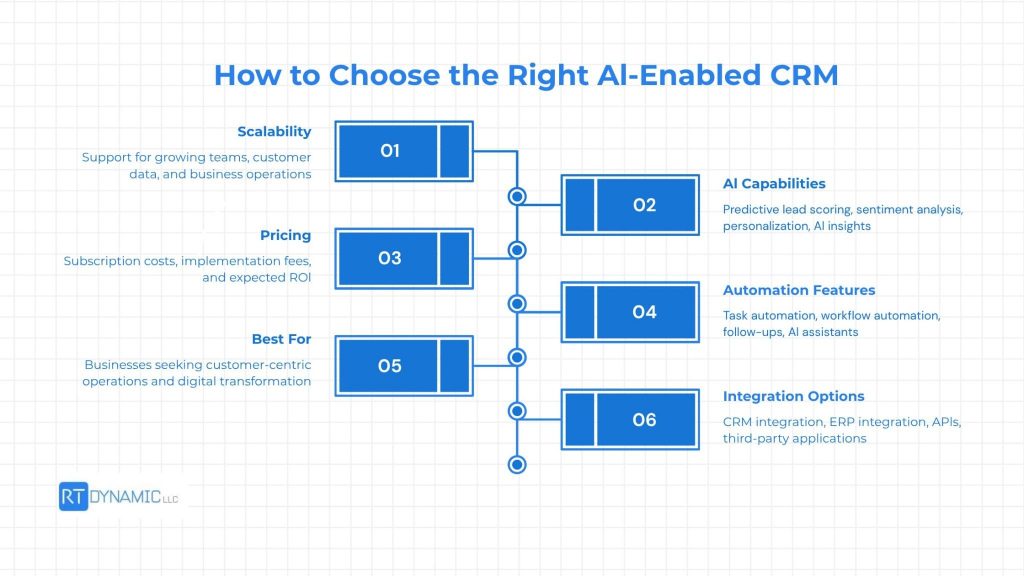
How to Choose the Right AI-Enabled CRM
Selecting the right intelligent CRM systems depends on your business goals, AI capabilities, and long-term scalability. Compare platforms based on value, automation, and integration before making a decision.
Measuring the Success of Your AI CRM
Measuring performance helps businesses understand whether AI CRM solutions are delivering real value. Tracking the right metrics supports continuous improvement and long-term success.
Track Productivity Improvements
Measure time saved through automation and reduced manual work. Higher productivity allows teams to focus on customer engagement and sales.
Monitor Customer Satisfaction
Track customer feedback, response times, and retention rates. These metrics show how AI-powered CRM improves the customer experience.
Measure ROI and Sales Growth
Evaluate revenue growth, lead conversions, and return on investment. These results help determine the overall impact of your AI CRM strategy.
The Future of AI-Enabled CRM
The future of AI-powered sales CRM is driven by autonomous AI agents, predictive customer journeys, and Voice AI. These technologies will automate decisions, personalize interactions, and improve customer experiences across every touchpoint.
Hyper-personalization and self-optimizing CRM workflows will help businesses adapt in real time. As AI-enabled CRM evolves, organizations will strengthen customer relationships, improve efficiency, and gain a lasting competitive advantage.
Conclusion
AI-enabled CRM transforms traditional CRM into an intelligent, action-driven platform. It improves sales, marketing, customer service, and business decision-making.
Choose AI CRM solutions that align with your goals, scalability, and ROI. RT Dynamics helps businesses implement, customize, and optimize AI-powered CRM solutions for long-term success.
Frequently Asked Questions
What is an AI-enabled CRM?
An AI-enabled CRM uses AI to automate tasks, analyze customer data, and improve business decisions.
How does AI in CRM improve business operations?
AI in CRM automates workflows, personalizes customer interactions, and delivers real-time insights.
What are the benefits of AI-powered CRM?
AI-powered CRM boosts productivity, improves forecasting, increases customer retention, and enhances efficiency.
How difficult is AI CRM implementation?
AI CRM implementation is straightforward with clean data, clear goals, and proper user training.
Can small businesses use AI CRM software?
Yes. AI CRM software helps small businesses automate work, improve customer service, and grow efficiently.