Key Takeaways
- Sales Cloud consulting aligns Salesforce with your sales process, goals, data, and team needs.
- Expert consultants improve implementation, automation, integrations, user adoption, and long-term scalability.
- The right consulting partner helps avoid costly mistakes and gets more value from your Salesforce investment.
What Is Sales Cloud Consulting?
Sales Cloud consulting helps businesses align Salesforce Sales Cloud with their sales goals and workflows. Consultants assess needs, design solutions, and manage implementation, automation, integrations, and optimization.
What Is the Sales Cloud in Salesforce?
Salesforce Sales Cloud is a CRM platform for managing leads, accounts, contacts, and opportunities. It also supports forecasting, dashboards, reporting, and automation for better sales efficiency.
What Is Cloud Sales and How Does It Support Sales Teams?
Cloud sales uses cloud-based tools to manage sales activities and customer data. Teams can access customer details, opportunities, and activities in one CRM for faster decisions.
What Is Cloud Consulting?
Cloud consulting provides guidance for planning, implementing, and improving cloud systems. For Salesforce Sales Cloud, it can include configuration, integrations, automation, and ongoing optimization.
Why Sales Cloud Consulting Matters for Salesforce CRM Implementation
Sales Cloud consulting helps businesses align Salesforce with their sales needs and workflows. Expert planning reduces data issues, poor adoption, and expensive rework.
Aligning Salesforce With the Sales Process
Consultants map the sales process before configuration, defining how leads become opportunities and deals move toward closing. This creates consistent workflows and clearer pipeline stages.
Designing Salesforce Around Business Requirements
Clear requirements guide Salesforce configuration, custom objects, fields, permissions, security, automation, and dashboards. Consultants can also create different views for specific user roles.
Improving User Adoption and Sales Productivity
Consultants simplify sales workflows, automate repetitive tasks, and provide role-based training. This helps teams spend less time updating records and more time managing opportunities.
Avoiding Costly Salesforce Implementation Mistakes
Poor planning can cause duplicate data, excessive Salesforce customization, and weak testing. Using standard features and testing workflows early helps prevent costly issues after deployment.
What Does a Salesforce Sales Cloud Consultant Do?
Sales Cloud Strategy and CRM Assessment
Consultants review the Salesforce instance, sales funnel, data quality, integrations, and business goals. This creates a practical CRM strategy.
Sales Cloud Configuration and Implementation
Consultants configure Salesforce Sales Cloud around business requirements, including objects, fields, permissions, workflows, and automation.
Lead and Opportunity Management
Consultants improve lead management through qualification, assignment, and follow-up rules. They also configure opportunity stages for better pipeline visibility.
Salesforce Automation for Sales Teams
Workflow automation handles lead routing, reminders, alerts, approvals, and notifications. This gives sales teams more time for selling and relationship building.
Salesforce Reporting and Sales Dashboards
Consultants create dashboards tracking pipeline value, conversion rates, win rates, sales velocity, and forecasts. These insights support faster, data-driven decisions.
Salesforce Integration and Data Management
Salesforce integration connects Sales Cloud with ERP, marketing, customer service, and email systems. Data synchronization keeps customer information accurate and connected.

What Does a Salesforce Sales Cloud Consultant Do?
A Salesforce Sales Cloud Consultant connects business needs with the right CRM solution. Their work covers assessment, implementation, integration, testing, training, adoption, and optimization.
Sales Cloud Strategy and CRM Assessment
Consultants assess the CRM, sales funnel, data quality, integrations, and business goals. They then map requirements to Salesforce capabilities and create a practical implementation roadmap.
Sales Cloud Configuration and Implementation
Consultants configure Salesforce Sales Cloud around business requirements, including objects, fields, permissions, workflows, and automation. Standard features are prioritized to avoid unnecessary complexity.
Lead and Opportunity Management
Consultants improve lead management through qualification, assignment, and follow-up rules. They also configure opportunity stages to improve pipeline visibility and sales efficiency.
Salesforce Automation for Sales Teams
Workflow automation can manage lead routing, reminders, alerts, approvals, and notifications. This reduces repetitive work and gives sales teams more time for selling.
Salesforce Reporting and Sales Dashboards
Consultants build dashboards covering pipeline value, conversion rates, win rates, sales velocity, and forecast accuracy. These insights help managers make faster, data-driven decisions.
Salesforce Integration and Data Management
Salesforce integration connects Sales Cloud with ERP, marketing, customer service, and email systems. Data cleansing and synchronization keep customer records accurate and reliable.
How Sales Cloud Consulting Supports a Successful Salesforce Implementation
Step 1: Discover Business and Sales Requirements
Consultants interview stakeholders and map current sales processes. They identify pain points and document the desired workflows and business requirements.
Step 2: Design the Sales Cloud Solution
Consultants turn requirements into a CRM strategy covering architecture, security, automation, reporting, and integrations. The design also considers different user roles.
Step 3: Configure and Customize Salesforce
Consultants use standard Salesforce Sales Cloud features wherever possible. Customization is added only when it solves a clear business need.
Step 4: Migrate and Validate CRM Data
Teams clean data, map fields, remove duplicates, and validate records before data migration. Reconciliation then confirms data accuracy before go-live.
Step 5: Test Sales Cloud Workflows and Integrations
Testing covers functionality, integrations, user acceptance, and regression scenarios. This helps catch errors before Salesforce deployment.
Step 6: Train Users and Launch Salesforce
Role-based user training prepares teams for their specific workflows. Consultants also support documentation, adoption, deployment planning, and go-live readiness.
Step 7: Monitor and Optimize Sales Cloud
After launch, consultants review adoption, user feedback, pipeline performance, and system analytics. Continuous optimization keeps Salesforce aligned with changing business needs.
Key Benefits of Sales Cloud Consulting
Better Sales Pipeline Visibility
Standardized opportunity stages give managers a clearer view of active deals. Salesforce Sales Cloud dashboards can show pipeline value, deal stages, and potential gaps.
Faster Lead Response and Follow-Up
Automated lead routing sends new leads to the right sales rep quickly. Automated tasks and reminders also reduce delays in follow-up and improve sales response times.
More Accurate Sales Forecasting
Consistent opportunity data gives managers a stronger basis for forecasting. Better sales processes can improve revenue planning and highlight deals that need attention.
Higher Sales Team Productivity
Automation removes repetitive tasks from the daily workflow. Sales reps can spend more time on customer relationships, selling, and deal closing.
Better Data Quality and Reporting
Validation rules, standardized fields, and deduplication keep CRM records more reliable. Cleaner data also produces more accurate reports and actionable insights.
Greater Salesforce ROI
Proper implementation reduces costly rework and encourages stronger user adoption. When teams use Salesforce effectively, businesses get more value from their CRM investment and support long-term growth.

Real-World Sales Cloud Consulting Use Cases
Salesforce Sales Cloud consulting helps businesses solve specific sales problems. Consultants identify workflow gaps and build solutions around business goals.
Fixing a Disorganized B2B Sales Pipeline
A growing B2B company may struggle with inconsistent stages and unclear ownership. A Salesforce consultant can standardize stages, rules, ownership, and dashboards.
Automating Lead Assignment and Follow-Up
High lead volumes can cause slow follow-ups and missed opportunities. Salesforce configuration can route leads automatically and create follow-up tasks.
Connecting Sales Cloud With Marketing and ERP Systems
Separate systems can create disconnected customer and revenue data. Salesforce integration connects campaign, customer, order, and revenue information.
Improving Forecasting for a Growing Sales Organization
Consistent opportunity data makes forecasting more reliable. Standardized stages and dashboards help leaders identify pipeline risks earlier.
Sales Cloud Consulting Services You Should Expect From a Partner
Salesforce Sales Cloud Implementation
Sales Cloud consultants should handle architecture, configuration, deployment, and stabilization. A clear implementation process should also define the project scope, milestones, testing, and go-live support.
Sales Cloud Data Migration
Consultants should assess, cleanse, map, and migrate existing CRM data. Data deduplication, validation, and post-migration reconciliation help maintain reliable records.
Salesforce Sales Cloud Integration
A partner should plan integrations with ERP, marketing, finance, customer service, and other systems. They should explain how data will move between systems and how integration issues will be handled.
Sales Cloud Customization and Automation
Consultants can customize workflows and automate repetitive sales tasks based on business needs. However, unnecessary custom code can increase maintenance costs and create technical debt.
Salesforce Training and Change Management
Role-based training helps sales representatives, managers, and administrators understand their specific workflows. A clear adoption plan also supports stronger CRM adoption after go-live.
Sales Cloud Optimization and Support
Post-launch support should include performance reviews, user feedback, workflow improvements, and ongoing troubleshooting. Before signing, confirm the SLA, support commitments, and issue resolution processes.
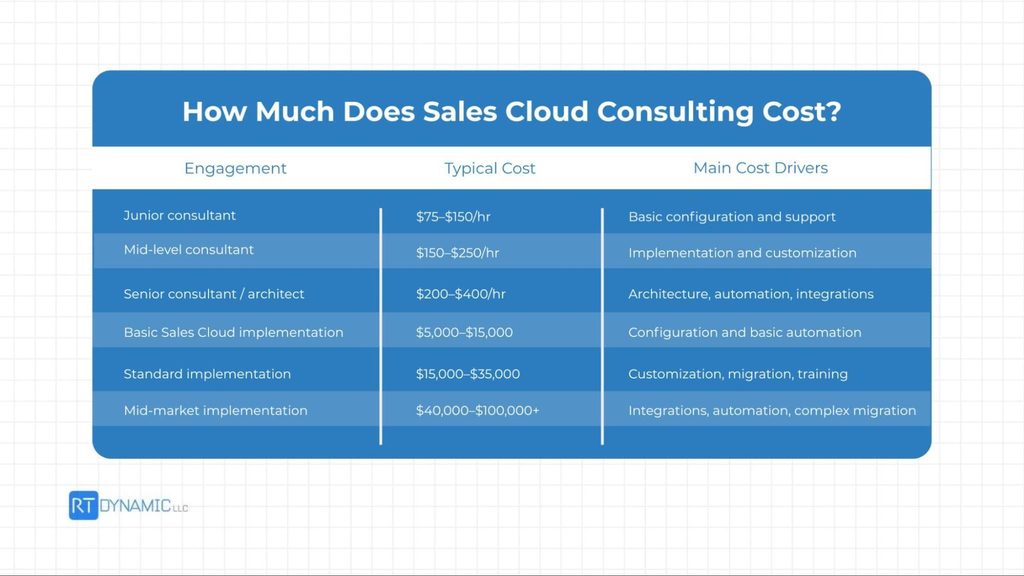
How Much Does Sales Cloud Consulting Cost?
Sales Cloud consulting costs vary based on project scope, consultant experience, location, and complexity. The following ranges are useful 2026 market estimates, not fixed Salesforce prices.
Factors That Affect Sales Cloud Consulting Costs
Project scope, customization, Salesforce integrations, data migration, user count, training, consultant seniority, and ongoing support can all increase costs.
How to Estimate Your Salesforce Consulting Budget
Define your scope, integrations, migration needs, consulting hours, and support requirements first. Then compare Salesforce consulting quotes based on deliverables and long-term value.
How to Choose the Right Sales Cloud Consulting Partner
Check Salesforce Experience and Certifications
Relevant Sales Cloud certifications show that consultants understand Salesforce capabilities and implementation practices. Also review their experience with projects similar to yours.
Evaluate Industry and Sales Process Experience
Choose consultants who understand your industry, sales model, and workflows. Familiarity with your processes can reduce customization and improve the final CRM setup.
Review Implementation Methodology and Communication
Ask how the partner handles discovery, documentation, testing, deployment, and project governance. Clear communication with stakeholders also helps prevent delays and misunderstandings.
Compare Top Salesforce Consulting Partners
Compare top Salesforce consulting partners by project experience, services, reviews, certifications, pricing, and post-launch support. Focus on proven results rather than credentials alone.
Ask About Post-Implementation Support
Confirm what happens after go-live, including SLA, troubleshooting, admin support, enhancements, and optimization. A strong partner should also offer a clear long-term Salesforce strategy.
Common Sales Cloud Implementation Mistakes to Avoid
Customizing Salesforce Before Understanding the Sales Process
Businesses should map their sales process and business requirements before adding custom workflows. Over-customization can increase system complexity and make Salesforce harder to maintain.
Migrating Unclean or Duplicate Data
Outdated, inaccurate, or duplicate records can damage CRM reports and data insights. Clean data migration helps maintain reliable dashboards, automation, and user trust.
Ignoring Integration Requirements
Integration needs should be planned during the Salesforce architecture stage. Delaying Salesforce integration can create data silos, inconsistencies, and costly implementation delays.
Launching Without Proper User Training
Even a well-built Salesforce instance can fail without proper user training. Role-based training helps improve user adoption, platform utilization, and confidence after deployment.
Measuring Implementation Success Too Late
Define KPIs before Salesforce deployment, including adoption, lead response time, pipeline visibility, conversion rates, and forecast accuracy. Early measurement makes it easier to identify gaps and optimize performance.
How RT Dynamics Can Help With Sales Cloud Consulting
RT Dynamics supports the Salesforce lifecycle, from strategy and implementation to migration, automation, integrations, training, and optimization.
Sales Cloud Strategy and Implementation
A clear strategy aligns Salesforce with sales goals and workflows. RT Dynamics supports requirements, configuration, deployment, and scalable Sales Cloud solutions.
Salesforce Integration and Automation
Connecting Sales Cloud with existing systems keeps data flowing across teams. Automation also reduces repetitive tasks and improves sales productivity.
Ongoing Salesforce Optimization and Support
As business needs change, Salesforce requires ongoing improvements. RT Dynamics provides support for troubleshooting, enhancements, adoption, and Salesforce optimization.
Conclusion
Sales Cloud consulting turns Salesforce into a CRM aligned with your sales processes, data, and business goals. It also helps improve adoption, automation, and long-term performance.
RT Dynamics supports Sales Cloud implementation, integration, customization, training, and optimization. This helps businesses get more value from their Salesforce investment.
Frequently Asked Questions
What Is Sales Cloud Consulting?
Sales Cloud consulting helps businesses plan, implement, integrate, and optimize Salesforce around their sales goals.
What Is Sales Cloud in Salesforce Used For?
Salesforce Sales Cloud manages leads, accounts, contacts, opportunities, pipelines, forecasts, and sales activities.
What Does a Salesforce Sales Cloud Consultant Do?
A Salesforce Sales Cloud Consultant assesses requirements, configures Salesforce, manages integrations, trains users, and supports optimization.
How Much Does Sales Cloud Consulting Cost?
Costs depend on project scope, customization, integrations, migration, consultant expertise, and ongoing support.
How Do I Choose a Salesforce Sales Cloud Consulting Partner?
Check their certifications, experience, industry knowledge, implementation process, integration skills, and post-launch support.
Is Salesforce Sales Cloud Worth It for Small Businesses?
Yes, especially for growing teams that need better pipeline management, automation, reporting, or scalable sales processes.